

What 4000 words on a Meta AI data center says about journalism right now
In an era of AI-generated everything, the value of being there in person is only increasing

How AI is affecting journalism was big news this week. There was the Wired story about how tech reporters on Substack are using AI to help write and edit their stories. There was the Wall Street Journal story about how one Fortune staffer is churning out a half-dozen stories a day prompted by AI (as you know, I work for Fortune).
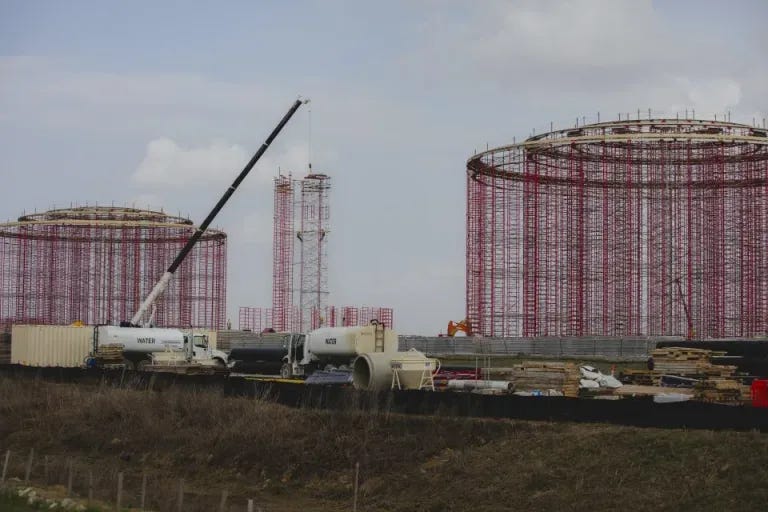
Meanwhile, my 4000-word tome on how Meta’s $27 billion new AI data center in northeast Louisiana is reshaping the region published this week. Bad timing for a deeply-researched, on-the-ground reported feature?
I say not.
The discourse, not surprisingly, has tilted towards a familiar argument: that AI is hollowing out journalism, that attention spans are collapsing, that the era of long-form, on-the-ground reporting is sputtering to an end, especially as tech reporters are struggling to keep up with the sheer pace of news.
Let’s be clear: I use AI in my work. All day, every day. AI transcribes my interviews, helps write my headlines, tightens my sentences, digs into research, translates technical jargon, offers feedback on hot takes, provides structural notes, and helps break up run-on sentences like this one, that threaten to race off into nonsensical oblivion and risk turning off even the most dedicated readers (maybe I should have had ChatGPT fix this example, but then it wouldn’t be an example, right?)
But I write my own stories, and some of them are damn long. There are those who say GenZ doesn’t read, that they get their news from short-form video, that if you’re struggling to pump-out long-form, original reporting, you’re not innovating. In the age of AI, even if isn’t slop, it needs to be short, sweet, and easy to digest.
I say that’s hogwash. I say that as respectfully as one can say “hogwash.” I say that as someone who has run the gamut of journalism/content over two decades. From deep dives and analysis to quick news hits, aggregation, humor pieces, trade mag write-ups, consumer mag features, blogs, white papers, sponsored brand content and oh, that stint writing tabloid celebrity write-arounds for InTouch Weekly where I sat on a train to Philadelphia with my cell phone tucked into the crook of my neck, desperately taking notes from a plastic surgeon about what he thought about Pamela Anderson’s side-boob.
There will “always” be room for long-form, original reporting, that journalists struggle to write. Reports of its death are greatly exaggerated. In fact, it might even be the future. Sure, it won’t be in print newspapers or magazines. Funding sources might differ, its focus might be more niche, the number of authors may shrink.
But just like Timothee Chalamet’s comment doesn’t mean ballet or opera are going anywhere, there will always be an audience for writing that emerges from original reporting on the ground. The value of being in-person is only increasing. And short-form video is not enough to get the full story.
This brings me back to Richland Parish, Louisiana, where the story of Meta’s mega AI data center is complex and messy and, in many ways, can only be experienced on the ground.
There, I could witness the hundreds of trucks hurtling in and out of the 4 million square foot Meta site, kicking up rocks that damage residents’ windshields. I could meet the local businesses that are thriving as a result of the project, as well as the ones that are struggling to get in on the action. I could meet the residents that are thrilled to see their relatively poor parish get Big Tech money; as well as those who are being priced out and even evicted to make room for thousands of out-of-state construction workers. I could drive by massive new “man camps,” RV parks meant to house those workers.
This isn’t the kind of story that emerges from a model output, even though AI helped me at many points along the journey to publication. No, it comes from being there and spending time and energy to report a complex, nuanced story. No churning out anything in this case.
I’m lucky that I had Fortune’s support to fly to Louisiana, rent a car and stay in a hotel. And, of course, I’m lucky that they considered the topic to be worthy of a deep dive.
But I also believe people will read this kind of story. No, not everyone, and not all the way through (though I highly recommend it!). But enough.
The real question is whether journalists will be allowed to keep doing original, in-depth reporting, whether it be deep dives like my Meta story or Big Tech scoops or long-form commentary and analysis. I say they should, or should do it independently — as so many here on Substack do. I am a paid subscriber of many, including Alex Kantrowitz, Casey Newton , Alex Heath , Jasmine Sun , Ashlee Vance and Jeffrey Ding .
In my AI beat, I think it’s essential, because the more AI reshapes the physical world and the people and companies living in it, the more we need journalism that goes out, sees it up close, and writes about it.
People will read 4000 words — or at least try — when it’s the kind of reporting they can’t get anywhere else. Books didn’t disappear, and neither will deeply-reported stories that have some real non-AI effort attached to them.
At least, that’s the bet I’m making right now: Read the full Meta story here.
I've been following you Sharon! Really great work.
Love the attitude in this piece. Love to see the vantage point 👉