

America's AI race is being fought on two fronts
The competition for AI leadership with China is no longer just a geopolitical story. It's also becoming a test of whether the United States can navigate the politics of building AI at home.

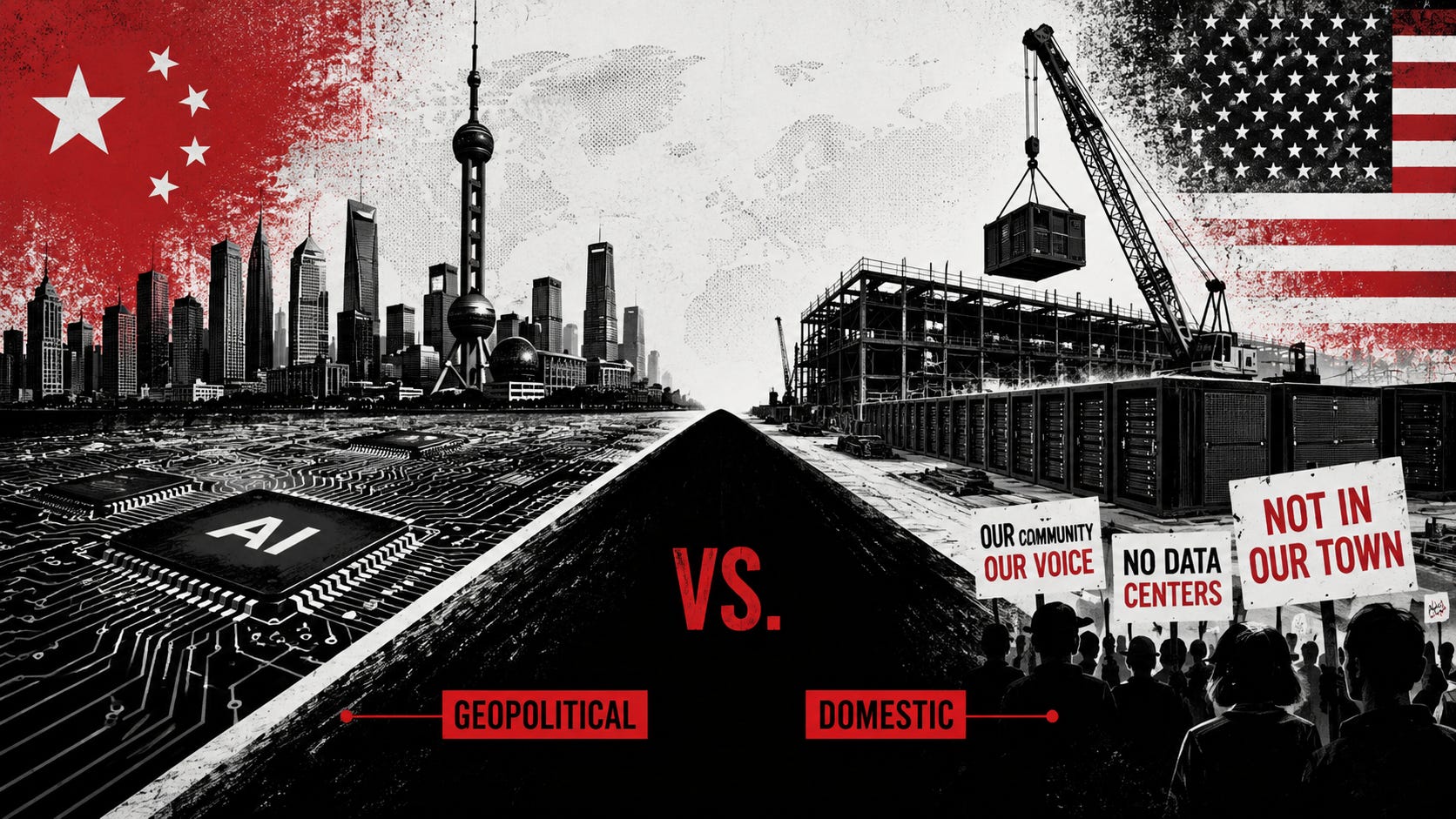
If you followed last week’s AI headlines, you’d be forgiven for thinking that the industry’s biggest challenge is nearly 7,000 miles across the Pacific Ocean from Silicon Valley, in China.
That’s because last Thursday, Beijing-based Moonshot AI unveiled Kimi K3, the latest model in its Kimi family of large language models. Its size and benchmark performance appear to put it in the same league as what has widely been considered the industry's leading model, Anthropic's Fable 5. But unlike Fable 5, Kimi K3 is an open-weights model, meaning it is publicly available for others to use, modify and build upon.
It was immediately clear to observers that this could be another “DeepSeek moment”—a reference to January 2025, when the Chinese AI startup shocked the world by unveiling a model that rivaled leading systems from OpenAI and Anthropic, while claiming it had cost far less to develop, required far fewer Nvidia chips to run and would be released for free.
DeepSeek's breakthrough challenged one of the central assumptions underpinning America's AI strategy: that the US could stay ahead with the most sophisticated AI chips, the best AI research talent and a speedy effort to build mega AI data centers to train and run models. But if Chinese frontier AI could be built with dramatically fewer resources—and then given away freely—that competitive advantage looked less certain.
The battle over AI in America’s own backyard
But the battle to win the AI race with China may be distracting the US from the other battle over AI emerging in its own backyard. As I reported in my Fortune series When AI Comes to Town, the race to build AI is transforming communities far from Silicon Valley. Developers are proposing and building massive new AI data center campuses that promise economic growth while raising concerns about water, energy and land use. The AI data center boom has produced a backlash that has been brewing for over a year and reached a crescendo in recent weeks.
Last week’s headlines were unmissable: The Washington Post reported that “Data centers have united Americans of both parties in a shared hatred.” The New York Times discussed whether the gathering coalition of Americans against data centers could be the next Occupy Wall Street movement or Tea Party. And The Conversation pointed out that “Americans hate AI so much that politicians are starting to lose their jobs over it.”
Even more concerning to me is a Wall Street Journal headline: “AI Backlash Has Tech Executives Fearing for Their Lives,” reporting that threats against AI companies are rising and spilling over into real-world security incidents.
Two related stories about what it will take to ‘win’ the AI race
At first glance, these seem like completely different stories. One is a geopolitical story about the US-China race to lead in frontier AI research and to build the world’s top AI models. The other is a domestic on-the-ground fight between communities and data center developers.
But they are actually intricately connected. AI models may be digital computing miracles of matrix multiplication, but training and running frontier LLMs requires a complex physical infrastructure supply chain made of concrete, fiber, and steel. The backlash against AI data center boom suggests that American AI companies and developers are struggling to earn enough public trust to keep building the infrastructure that is foundational to model-building success.
That has become even more challenging in recent months because opposition to data centers has become a proxy for a much broader debate over AI itself.
